Overcoming Taboo P-OCD: A Response
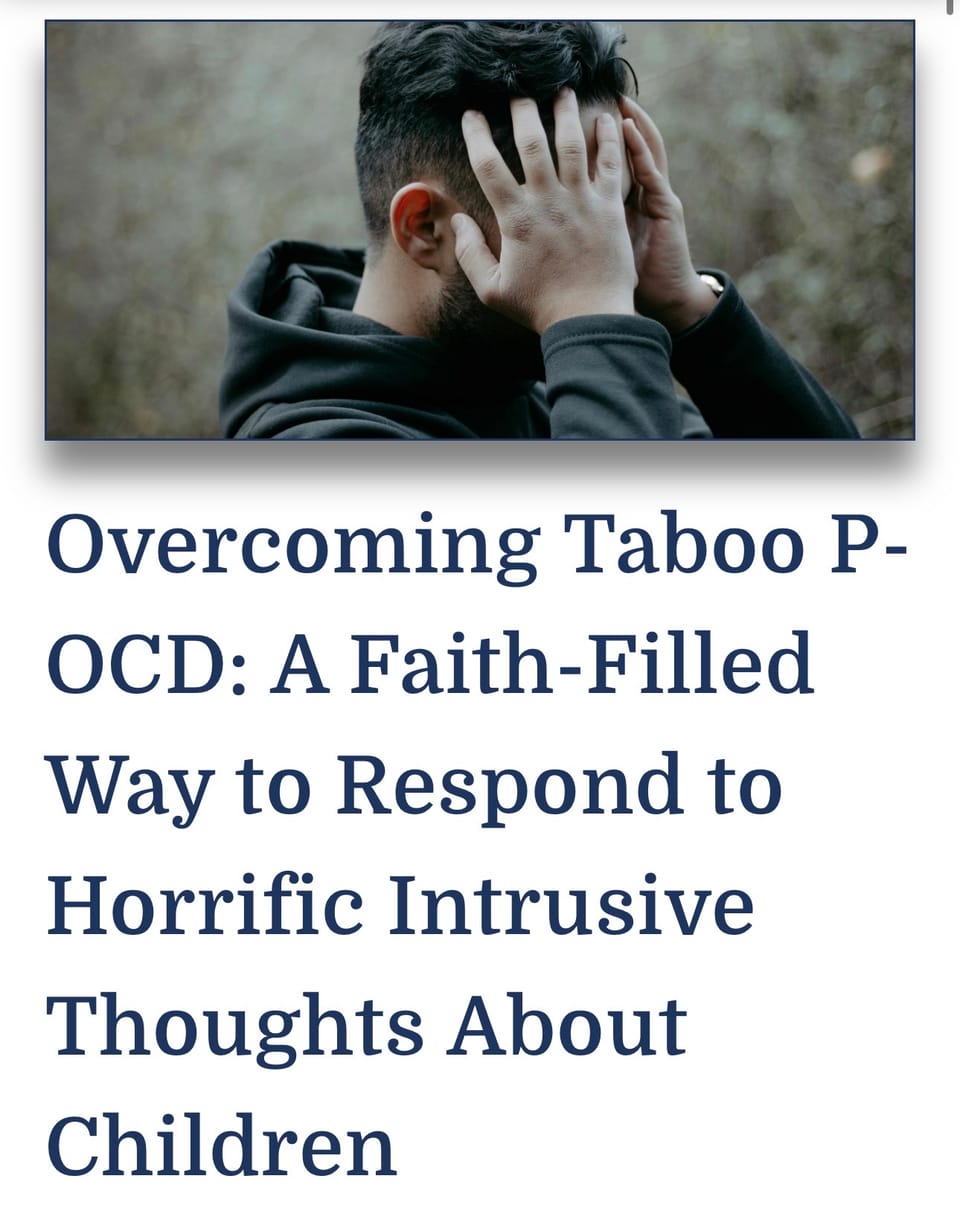
This was originally going to be a post on X. However, once I reached the 10th thread, I decided to pivot and put these thoughts in a more organized medium. So now what you get is a collection of random observations that may or may not make sense. Here’s hoping. These thoughts are primarily a response to the article linked below and are particularly addressing the “Key Takeaways” portion at the end of the article. Why respond at all you may ask? It’s a fair question. I would say my reasons are twofold: First, I love the local church and want to see her equipped for the work on ministry. Second, I love biblical counseling and the work of soul-care within the local church. It is a special thing to walk with someone through suffering and point them to Jesus. This love prompts a desire for clarity, especially when dealing with extremely serious subject manner.
I do want to say from the outset that I in no way have a desire to be click-baity in my responses, nor is it my desire to call into question the author’s desire to bring hope and healing those caught up in debilitating sin or suffering. However, there are particular issues I have with this article that I hope to bring forward here for discussion and consideration. As always, let us remember that whatever the sin or struggle may be, we confess with great joy that all hope that may be found in our Savior Jesus. In Him there is no darkness. In Him there is all light.
For context, here is the original article:
“P-OCD = unwanted thoughts, not one's identity or desires.”
It is true our identity is found in Christ. We confess this with great confidence. Yet true things can have an unhelpful and even an unbiblical application. This is not an issue with the truth itself, but rather our understanding of it. I believe this to be the case in this instance. I would attest that P-OCD is more than simple “unwanted thoughts.” Just as we would rightfully call out the seriousness of someone’s feelings or desires to unlawfully take a life (murder) or commit a forced, sexual act against another (rape), the same standard should be applied here. If someone were to confess these desires, my hope is that they would be considered with greater seriousness than simply “these are unwanted thoughts.” I believe this standard applies in this context. These “unwanted thoughts” are serious. Extremely serious. The downgrading of language in this instance is of great concern to this soul-care provider.
So why the degradation in language? In short, my theory is that there is always a great propensity to lessen the language of issues that are the “hot button” topics of the day. The same can be seen with issues involving the LGBTQ (and now P) conversations. In my opinion, downgrading pedophilic thoughts/desires to “unwanted thoughts” is unwise at best and dangerous at worst. As a rule, we must avoid the degradation of biblical language simply to appeal to or comfort those we are counseling. We do a disservice to them when we do this. Proverbs 12:17-18 reminds us that “whoever speaks the truth, gives honest evidence, but a false witness utters deceit.”
“Anxiety, shame, and self-condemnation are understandable responses to taboo thoughts.”
On the surface, this would seem like a very sound and reasonable statement to make. In most contexts, I would find myself agreeing with and even providing examples to prove its veracity. However, I believe in this particular instance it is an unhelpful and misleading statement to make. My main issue with this statement comes down to the use of the word “taboo.” You’ll find through this article that one of my main issues/critiques is with the specific degradation of language. As already stated above, I believe this to be a great detriment to those that we are counseling. In lieu of this, my question is simple: when did pedophilic thoughts/desires become describable as “taboo?” When did we allow for such provisions in this particular issue? When did it become anything less than sin?
Again, would we treat the thoughts/desires to sexually overpower a weaker person with the same provision? Would we consider an individual’s desire (unwanted though it may be) to take the life of someone else to be simply “taboo?” I would hope that we have not come so far in our desire to be gracious that we would abandon all manner of biblical language and discernment. The thought or desire to sexually harm a child is not natural nor is it simply “taboo.” I believe there are some very well-meaning counselors that are setting a very dangerous precedent when they seek to co-opt the language of the world to describe an issue of the soul.
“Thought-action fusion is a trap — thoughts do not equal desire or action.”
I understand what the author is saying here, and I do believe there is a danger in making a 1:1 comparison between our thoughts or temptations and the acting on those thoughts and temptations. Temptation is not always sin. However, I think we need to be careful to not make provisions where the Scriptures gives principles. It is true that our thoughts do not always equal desire/action, but we must be aware that our thoughts and desires are linked. Not the same, but linked. Jesus uses the example of hatred to describes this principle in Matthew 5:21-22. “You have heard that it was said to those of old, ‘You shall not murder; and whoever murders will be liable to judgment.’ But I say to you that everyone who is angry with his brother will be liable to judgment; whoever insults his brother will be liable to the council; and whoever says, ‘You fool!’ will be liable to the hell of fire.” On the topic of lust, see also verse 28 of the same chapter. “You have heard that it was said, ‘You shall not commit adultery.’ But I say to you that everyone who looks at a woman with lustful intent has already committed adultery with her in his heart.”
Why do I bring this up? To make the simple argument that although it is true our thoughts do not always equal action, making a hard separation between the two can set a dangerous precedent. This separation can become unhelpful and actually result in the unintentional condoning/normalizing of something that should not be normalized. The above blanket statement “thoughts do not equal desire or action” is simply just a false statement. There are times where our thoughts actually do equal desire and those desires are sinful. We must leave room for this reality as counselors.
I believe that many counselors have such a propensity to avoid their counselees feeling guilt or shame due to their sin that they swing the pendulum too far to the other side and avoid sin-language altogether. Because of this, we see the degradation of sin language within the counseling room. When the language of sin is downgraded, the feelings of guilt and shame that should accompany that sin will also be diminished. This in turn will result in a feeling and disposition of apathy, or even worse, normalcy toward the particular sin. Like it or not, that’s the way the road winds. Are we truly comfortable walking down this road when it comes to pedophilia? I truly hope we are not.
“Rejecting compulsions weakens OCD.”
True. That’s how any sin or sinful desire works. Starve the flesh and the flesh will weaken. My issue here is not so much with this particular premise, but with the assertion that pedophilic thoughts should be qualified as a symptom of OCD. I am sure this is where the crux of the disagreement would lie with myself and the author. I’m simply not willing to concede that pedophilic thoughts or desires is on par with the average issue that many would classify as a symptom of OCD. This isn’t excessive handwashing or nervous, compulsive tapping. It’s not an unwarranted propensity to worry or an obsession with control. It’s having sexual thoughts about a child. Call me old fashioned, out of touch, or uneducated, but classifying pedophilic thoughts as a symptom of OCD is a dog that just won’t hunt.
“God's love in Christ is unchanging, even with intrusive thoughts.”
Agreed. Praise the Lord! I agree wholeheartedly that the love of Christ is an unchanging reality despite even our worst failings. This is undoubtedly the hope that biblical counseling brings. There can be real change, real joy, and real freedom because Jesus has conquered our sin. If this is not the base of your counseling, I would argue that you are not counseling from a correct source.
All these things being true, we have to be very careful not to utilize this truth in a way that normalizes the sinful thoughts or desires in our counselees. Again, I would argue that someone dealing with these type of thoughts and struggles is dealing with more than simply “intrusive thoughts.” That term is quaint, but I do not believe it does well in accurately describing the issue and the urgency the issue demands. When we use lesser language to describe greater issues, we do not make the issues themselves easier to manage. We simply muddy the waters for our counselees and make it harder to see the bottom. This is true when we call addiction a “disease” or pedophilic thoughts “intrusive.” At the end of the day, all this accomplishes is a “well that doesn’t sound too serious” mentality and a lack of urgency for things that are inherently urgent.
We can and should speak clear truth to those in our care without feeling the need to downgrade or normalize the struggles they are dealing with. We do this in love and with all gentleness (Eph 4:2). I would make the claim that in this particular case, classifying P-OCD as “intrusive thoughts” does not do justice to the issue, nor is it loving the individual that is struggling with it.
Final Thoughts
There are some sinful thoughts/desires that come more naturally to the man or woman. Things like anger, pride, selfishness, and yes, even lust. This does not mean we normalize them, but we realize they are more common and generally shared by most people to one degree or another. There are other sinful desires that are more severe and I would say are a result of some of the more common sins being allowed to run amuck. Yes, I believe that sin begets sin. For example, anger is a common sin that all Christians will deal with at one point or another. A desire to physically harm or murder someone due to anger has gone beyond the boundaries of “common” and shows that the anger has reached a new level of seriousness. In the same way, lust has the potential to turn into a desire to dominate sexually due to use of pornography and an unwillingness to address the addiction. Parent sins beget child sins and the child sins have the “Rehoboam mentality” from 1 Kings 12 when he boasted “My little finger is thicker than my father’s thighs.” If these child sins are left on their own, they grow and dwarf their parents in size and seriousness.
This is how sin works. It has a beginning and will grow in severity unless dealt with biblically. None of these actions should be completely separated from our thoughts. James 1:13-15 says “Let no one say when he is tempted, “I am being tempted by God,” for God cannot be tempted with evil, and he himself tempts no one. But each person is tempted when he is lured and enticed by his own desire. Then desire when it has conceived gives birth to sin, and sin when it is fully grown brings forth death.”
Part of my confusion is that it seemed as if the article (unintentionally?) attempts to normalize P-OCD and place it on par with other more common issues that we deal with as counselors. If you were to take a snapshot of the average day in pastoral counseling you would have a lineup of some common offenders like so: “My name is Josh and I struggle with depression” or “my name is Bridget and I am struggling with hopelessness in my marriage.” Then you have this article’s example that comes into the office and says “hi, my name is Katie and I struggle with sexual thoughts toward children.” Hold the phone. One of these is not like the others. Yes they are all issues that can and should be ministered to through the truth of the Scriptures and the hope of Jesus Christ, but that does not mean that all issues we face are equal in their severity. My worry with the degradation of language we see in this article is that it takes the more common issues deal with and the extreme issues (that are often a result of either unrepentant sin or horrific events in the person’s past), and places them on the same shelf. I don’t believe it’s wise to do this and I believe it will have long-term consequences if this practice is continued.
As a means of some closing encouragement, I would like to provide some helpful reminders:
- All sinful actions begin in the mind, not apart from it. (James 1:13-15)
- Avoid the use of “lesser language” when specificity is needed. (Prov 27:5-6)
- Our response to sin should always be truth fueled and grace filled. (Gal 6:1)
- Always point your counselee to the hope that is found in Christ. This hope is greater than any sin or struggle we will experience. (Rom 5:20-21)
I hope these thoughts have at least created some consideration. Again, I am not doubting the author’s desire to care for those that are struggling. Although I am concerned with how we go about that care. Language is important. Definitions are important. This world we live in is always seeking to approve what is evil and disapprove what is good. We know this as counselors. We must be on guard when we see something being normalized in the world. This is currently happening with P-OCD. Worldly language can have its uses, but only when the language is first rooted in the truths of Scripture. In this particular case, I find the negative consequences of this article to be greater than the hope it was trying to produce.